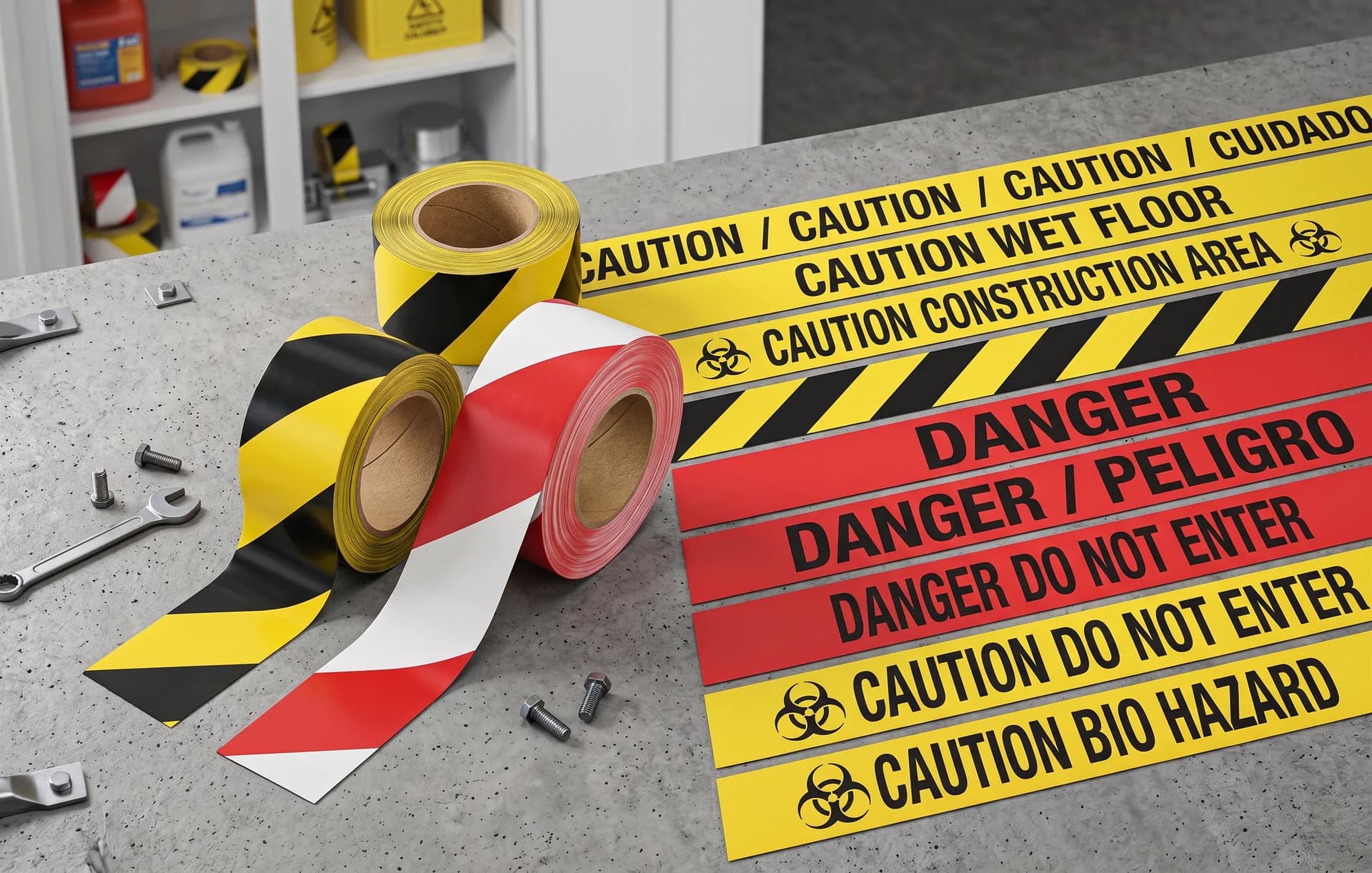
Tape is the fastest perimeter there is. It will not stop anyone who has decided to walk through it, and it is not a substitute for a physical barrier — but for marking a hazard, closing an area for a few hours, or keeping foot traffic off fresh work, nothing deploys faster or costs less.
A-1 Barricades stocks the standard caution and danger tapes along with specialty printed rolls for the situations that need specific wording.
What's in this category
- Caution tape
- Yellow with black CAUTION legend. The general-purpose warning tape for hazards and temporary boundaries.
- Danger tape
- Red with white or black legend, for hazards that carry a genuine risk of serious injury.
- Barricade tape
- Red-and-white or black-and-yellow diagonal striping for physical closures and exclusion zones.
- Printed and specialty tape
- Wet floor, do not enter, construction area, bio-hazard and bilingual legends.
- Underground marking tape
- Detectable and non-detectable tape buried above utility lines to warn future excavators.
Getting it right
Tape communicates; it does not restrain
Barricade tape is a visual boundary. Where the hazard is severe, where children or the public are present, or where the closure must hold overnight, use a physical device — barricades, fencing or bike-rack barriers — and use the tape to reinforce the message rather than to carry it.
Run it at a height people actually see
Roughly waist height reads as a boundary; ankle height reads as a trip hazard and head height gets walked under. Anchor to solid points, keep the run reasonably taut, and check it after weather.
Buy the heavier gauge for long or windy runs
Thin tape is fine for a short interior run. Outdoors, across a long span, or in wind, a heavier gauge is what keeps the perimeter from snapping and littering the site by morning.
Where we work
A-1 Barricades operates from 1415 Stuart Street in Chattanooga and has supplied traffic-control equipment across the Southeast since 1977.
20Communities across 3 states
Southeast Tennessee
- Chattanooga
- East Ridge
- Red Bank
- Soddy-Daisy
- Signal Mountain
- Hixson
- Ooltewah
- Collegedale
- Cleveland
- Dayton
- Jasper
Northwest Georgia
- Fort Oglethorpe
- Ringgold
- Dalton
- LaFayette
- Chickamauga
- Trenton
Northeast Alabama
- Bridgeport
- Stevenson
- Scottsboro
Barricade Tape questions
What is the difference between caution tape and danger tape?
Severity. Yellow CAUTION tape marks a hazard that calls for care — an uneven surface, a wet floor, a work area. Red DANGER tape marks a hazard that can cause serious injury or death and generally means do not enter at all. Using red for routine situations dilutes it, so save it for when it is warranted.
How long does a roll of barricade tape last?
Typical rolls run 1,000 feet, which covers a substantial perimeter. Outdoor service life is limited by sun and wind rather than by use — expect UV to embrittle polyethylene tape over weeks of exposure, and plan on replacing long-standing runs rather than assuming they will hold.
Is barricade tape legally sufficient to close off an area?
Not on its own for serious hazards. Tape is a warning device, not a barrier, and it does not physically prevent entry. Where a closure has to be enforced — around excavations, near the public, or overnight — pair it with physical barricades or fencing. Site-specific requirements may also be set by OSHA rules or by the governing agency.
Need gear on site?
Call for a quote, to reserve rentals, or to check stock. The people who answer the phone know the equipment.