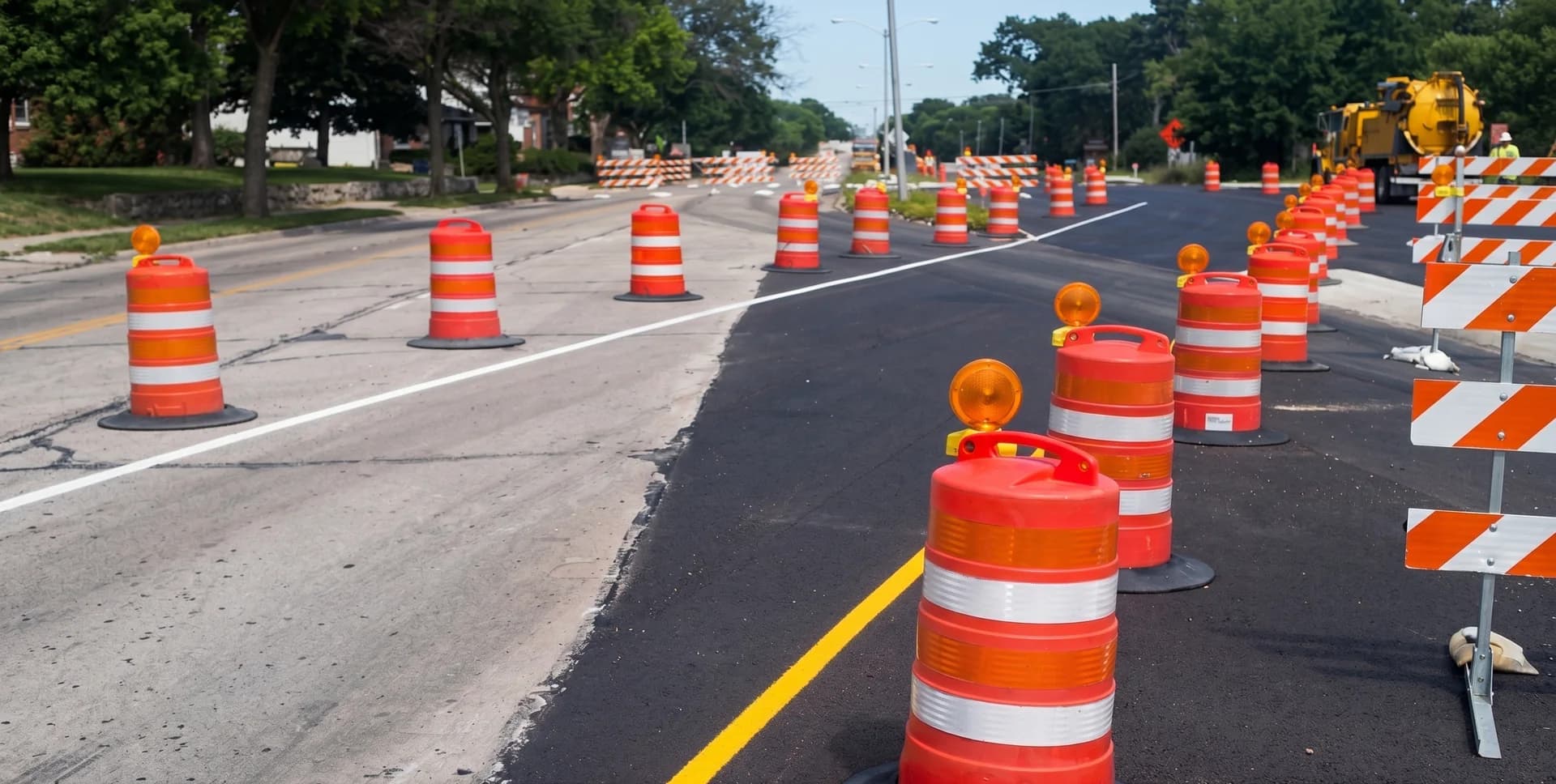
Channelizing devices are the guardrail of a work zone made out of plastic — they draw the line a driver follows through a taper and around the work. Drums, cones, tubular markers and vertical panels all do the same job at different sizes and for different speeds.
These are the highest-turnover items in traffic control: they get struck, run over, faded and lost. A-1 Barricades stocks them for purchase and rents them by the job for closures and events across the Chattanooga area.
What's in this category
- Traffic drums
- The 36-inch orange-and-white striped drum. The most visible channelizing device short of a barricade, and the standard on higher-speed roadway work.
- Traffic cones
- 18-inch through 36-inch cones, with and without reflective collars. The workhorse for lane closures, parking control and short-duration work.
- Tubular markers
- Narrow vertical channelizers for tight spaces and lane separation where a drum will not fit.
- Vertical panels
- Narrow striped panels used where lateral space is limited but a tall, visible device is still needed.
- Delineator posts
- Flexible posts that mark an edge or a lane line and rebound after being struck.
- Bases and ballast
- Recycled-rubber drum and post bases, cone weights and ring ballast.
Getting it right
Cone height tracks speed
Eighteen-inch cones are adequate for low-speed and daytime work. Once speeds exceed 40 mph, or the work runs at night, the MUTCD calls for a minimum 28-inch cone — and 28- and 36-inch cones with reflective collars are what agencies specify for freeway work. Buying short cones for a high-speed road is a false economy that will fail an inspection.
Drums outperform cones where you need to be seen
A 36-inch drum presents far more retroreflective area than a cone and stays upright in wind and turbulence from passing traffic. On multi-lane, higher-speed or long-duration setups, drums are the device that holds the taper.
Spacing is what makes a taper read
Devices spaced too far apart stop reading as a continuous line and drivers cut the corner. Taper spacing derives from the posted speed and the taper length in the traffic-control plan — closer through the taper, wider along the tangent.
Where we work
A-1 Barricades operates from 1415 Stuart Street in Chattanooga and has supplied traffic-control equipment across the Southeast since 1977.
20Communities across 3 states
Southeast Tennessee
- Chattanooga
- East Ridge
- Red Bank
- Soddy-Daisy
- Signal Mountain
- Hixson
- Ooltewah
- Collegedale
- Cleveland
- Dayton
- Jasper
Northwest Georgia
- Fort Oglethorpe
- Ringgold
- Dalton
- LaFayette
- Chickamauga
- Trenton
Northeast Alabama
- Bridgeport
- Stevenson
- Scottsboro
Drums & Cones questions
What size traffic cone do I need?
Match cone height to speed and lighting. The MUTCD sets a minimum of 18 inches for general daytime use, and a minimum of 28 inches where speeds exceed 40 mph or where cones are used at night. Higher-speed roadway work commonly specifies 28-inch or 36-inch cones with retroreflective collars so they return light to headlights at distance.
When should I use drums instead of cones?
Use drums when visibility and stability matter most — higher speeds, multiple lanes, nighttime work, or any setup that will stand for days rather than hours. A drum is at least 36 inches tall with wide retroreflective stripes, so it reads from much farther away than a cone and resists being blown or blasted out of position by passing traffic.
How far apart should channelizing devices be spaced?
Spacing comes from the traffic-control plan and scales with posted speed: devices sit closer together through a taper, where drivers are being moved laterally, and can be spaced farther along the straight run beside the work. The governing idea is that the devices must read as a continuous line rather than as separate objects.
Are traffic cones and drums available to rent?
Yes. Cones, drums and channelizing devices are among the most commonly rented items for closures, paving projects and events, because quantities spike for a few days and then are not needed again. Call (423) 265-3054 with dates and quantities.
Need gear on site?
Call for a quote, to reserve rentals, or to check stock. The people who answer the phone know the equipment.