Barricades
Type I, II and III barricades plus pedestrian bike-rack barriers.
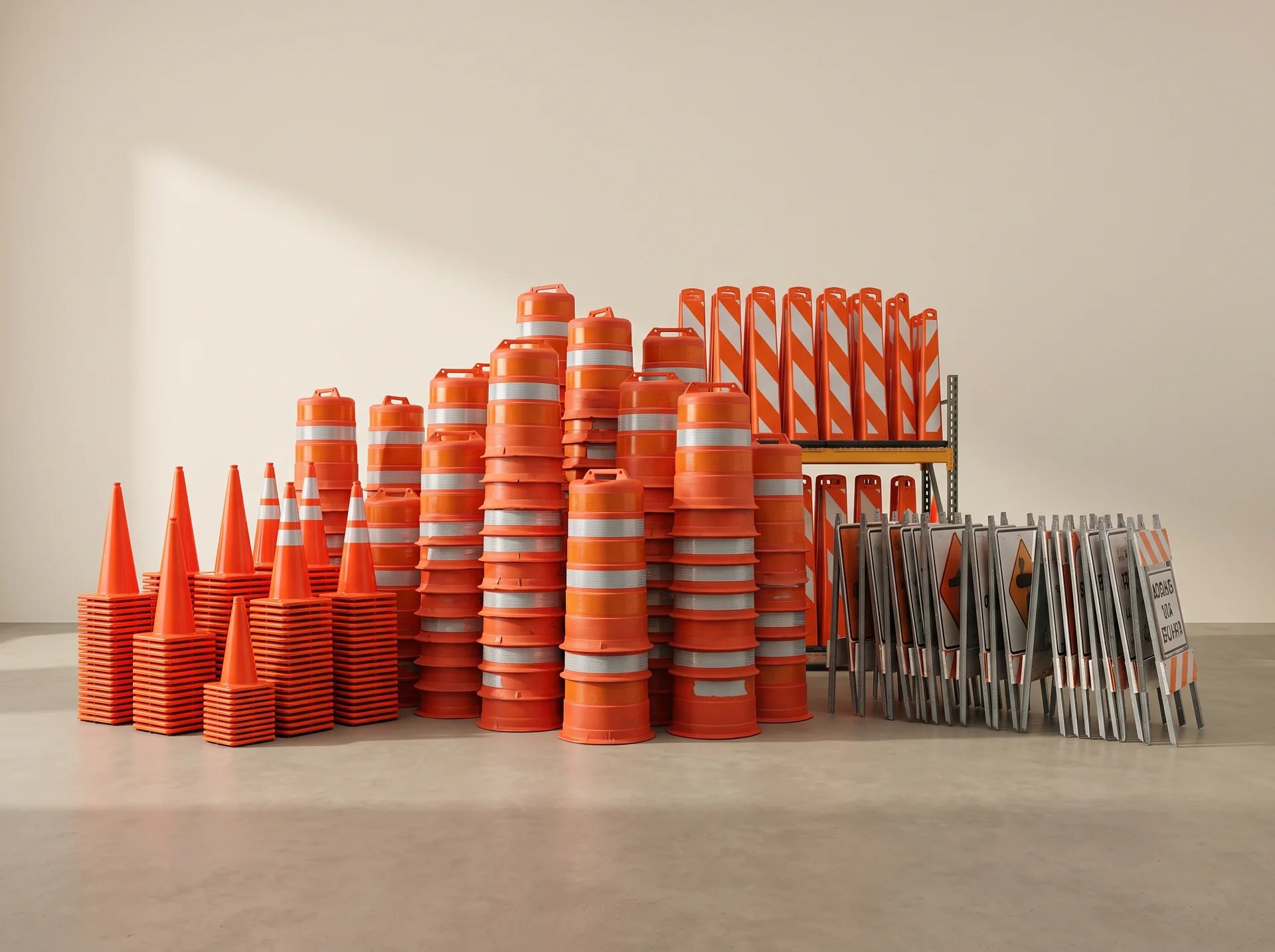
Barricades do two jobs at once: they tell drivers a route is closed or narrowed, and they physically mark the line a vehicle should not cross. The MUTCD sorts them into three types by how many reflective rails they carry, and the type you need follows from how completely the road is closed.
A-1 Barricades supplies all three types plus the interlocking steel bike-rack barriers used for crowd control at events — for outright purchase or for rent by the job.
What's in this category
- Type I barricades
- A single reflectorized rail on a portable frame. Used for lower-speed situations and to mark hazards where a full closure is not in play.
- Type II barricades
- Two reflectorized rails. The common intermediate device for roadway and street work, often carrying a warning light.
- Type III barricades
- Three rails, typically spanning the full roadway width. This is the road-closure device — what goes across a street that is genuinely shut.
- Pedestrian / bike-rack barriers
- Interlocking steel panels that form a continuous run. Used for crowd control, parade routes, event perimeters and pedestrian channelization.
- Water-filled barriers
- Plastic barrier sections shipped empty and filled on site for weight — a distinct class of device with its own specification rules, covered in full under Water-Filled Barriers.
- Barricade lights and hardware
- Type A flashing and Type B/C steady-burn warning lights, mounting brackets, sandbags and ballast.
Getting it right
The stripes are an instruction, not decoration
Barricade stripes slope downward toward the side traffic should pass on. Set a barricade backwards and you are pointing drivers into the closure. On a full closure with traffic passing both sides, chevrons point outward in both directions. This is the single most common field error with barricades.
Pick the type from the closure, not the budget
A Type III is what a closed road calls for — three rails, full width, unmistakable at distance. Type I and II handle narrowing, hazard marking and lower-speed work. Substituting down to save money on a genuine closure is exactly the shortcut that ends up in an incident report.
Ballast matters more than people expect
An unballasted barricade is a wind event away from being in the travel lane. Sandbags belong low on the frame or on the feet, not on top of the rails where they raise the center of gravity and can become a projectile if struck.
Where we work
A-1 Barricades operates from 1415 Stuart Street in Chattanooga and has supplied traffic-control equipment across the Southeast since 1977.
20Communities across 3 states
Southeast Tennessee
- Chattanooga
- East Ridge
- Red Bank
- Soddy-Daisy
- Signal Mountain
- Hixson
- Ooltewah
- Collegedale
- Cleveland
- Dayton
- Jasper
Northwest Georgia
- Fort Oglethorpe
- Ringgold
- Dalton
- LaFayette
- Chickamauga
- Trenton
Northeast Alabama
- Bridgeport
- Stevenson
- Scottsboro
Barricades questions
What is the difference between a Type I, Type II and Type III barricade?
The number of reflectorized rails. A Type I has one rail, a Type II has two, and a Type III has three and is normally the widest. The progression tracks severity: Type I and II mark hazards and narrowed roadways, while a Type III is the device used to close a road, typically spanning the full width of the closure.
Which way should barricade stripes point?
The stripes slope downward in the direction you want traffic to travel — toward the open side. If traffic passes on the right of the barricade, the stripes run down toward the right. When traffic can pass on either side, the rails are striped so the chevrons point both ways from the center. Installing them reversed sends drivers toward the closure.
Should I rent or buy barricades?
Rent when the need has an end date — a single project, a festival, a street closure, a seasonal event. Buy when barricades will be redeployed across many jobs, when you need them available on no notice, or when storage is not a constraint. Contractors who run continuous work generally own a core set and rent to cover peaks.
How many barricades do I need for a road closure?
That comes from the traffic-control plan for the job, which accounts for roadway width, speed, sight distance, detour routing and the advance-warning area ahead of the closure. A full closure needs devices at the closure itself plus advance signing and often channelizing devices along the taper. Tell us the road, the speed and the duration and we can talk through what a setup normally takes.
Need gear on site?
Call for a quote, to reserve rentals, or to check stock. The people who answer the phone know the equipment.